





Eye For Film >> Movies >> Roqia (2025) Film Review



They are experiences which many films have compared, pregnancy and possession, but from the perspective of Wafaa (Hanaa Mansour), they are very different. Although she misses her husband, who is away on military duties, she is very happy about her pregnancy, and she has a kindly neighbour (Akram Djeghim) to support her. She would rather die, she tells him, than be possessed as she once was in the past; having something insider of her like that was the worst feeling ever.
Her neighbour understands. He’s a carer, looking after an elderly raqi man (Mostefa Djadjam) who is gradually succumbing to Alzheimer’s disease. This is a man with experience of evil jinn, and as his mind starts to unravel, he seems to be losing the connection to Allah which provided him with protection. The carer becomes concerned as disturbing incidents begin to happens, with Qur’anic verses annotated in disturbing ways and sometimes even recited backwards. This is significant in a film which, on a larger level, is concerned with the misinterpretation of scripture.
All of this action is preceded by chaotic opening scenes which will be as shocking and confusing to most viewers as they are to the characters who find themselves under attack. Those familiar with Algerian history, however, may quickly identify this as one of the several brutal village massacres carried out by extremists during the country’s ‘black decade’ (between 1992 and 2002). It’s a very direct way to talk about evil, and sets the tone for the film as a whole. Supernatural possession is closely intertwined with the idea of radicalisation, evil jinn with distorted ideology.
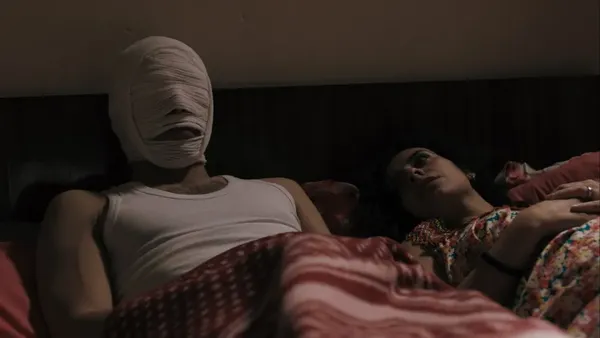
This theme finds its most direct expression in the film’s middle section, which deals with Ahmed (Ali Namous), a man who suffered a breakdown and got into a car accident after returning from war in Afghanistan (which, in this period, was frequently associated with extremism and violent tactics overstepping the traditional rules of war). Amnesiac and with his face swathed in bandages – terrifying to the youngest of his children – he remains in a fragile state but is gently supported by his wife, Selma (Lydia Hanni). As time passes he struggles with what seem to be flashbacks or nightmares, in which he is surrounded by a group of men whose whispered words, though he doesn’t understand them, seem to betoken something horrific. He has been struggling to regain his memory and sense of identity, but the more he learns, the more he feels that he does not want to become that man again.
These intersecting storylines build towards a conclusion which is all the more devastating because of its relationship with real life incidents. The film features exorcism scenes much more raw and powerful than most Westerners will be used to, and there’s some gory stuff elsewhere as well, though in context it’s really quite restrained. Although familiarity with Algerian history and culture adds depth to the experience, it’s not essential to following the story. Horror fans will sometimes find that they are likewise one step ahead, tilting the film away from something that is simply scary and more towards tragedy. However you approach it, there’s no denying that Roqia is very well made, with some wonderful performances (Djeghim is probably the standout), and it makes its point well.
Reviewed on: 29 Jun 2026